
Search books and reports
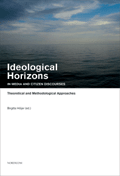
Ideological Horizons in Media and Citizen Discourses: Theoretical and methodological approaches
In which ways does the media discursively make sense of contemporary society? In which ways does the public, through the media, deal with and negotiate ongoing changes in society? How can we study this?

Ambivalence Towards Convergence: Digitalization and Media Change
Concepts of convergence and converging processes have triggered considerable attention and activities in media research during recent years. This has been an inspiring context for the discussions and analyses presented in this book.


Media Trends 2006 in Denmark, Finland, Iceland, Norway and Sweden. Radio, TV and Internet
Media Trends 2006 offers a broad picture of the radio, TV and Internet landscape in the Nordic countries. Commentaries examine developments country by country, while detailed comparative Nordic statistics present each media with respect to structure, ownership, economy, content and penetration/reach and consumption. Moreover, the publication includes analyses and overviews of media regulation and policies for the three media sectors with a Nordic comparative focus.
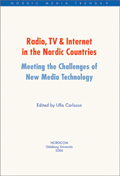
Radio, TV and Internet in the Nordic Countries: Meeting the Challenges of New Media Technology
Radio, TV & Internet in the Nordic Countries. Meeting the Challenges of New Media Technology brings together a number of scholars from different Nordic countries to shed light upon issues of vital importance that arise when dealing with television, radio and Internet in the Nordic media landscape; such as convergence, Internet and the public sphere, public service broadcasting in the new media landscape, Nordic radio digital development and the media policy of the European Union.

News from the Interview Society
During the 20th century, the interview has evolved in such a way that it has become the dominating form for talk and text production in the mass media (i.e. in newspapers, radio, television). This book introduces the Interview Society as an innovative, provocative and challenging concept to understand the construction of news, the use of language, and the power of journalism in contemporary media society.
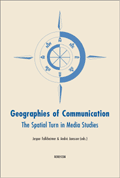
Geographies of Communication: The Spatial Turn in Media Studies
The relationship between space and communication is becoming more complex. Mediatisation blurs the boundaries between different spaces, as well as between dimensions of space. It also leads to the re-articulation of geographical territories – often (re)producing socio-political values and power struggles. This book departs from the assertion that the changing character of media society calls for a spatial turn in media studies. There are clear signs that such a turn is on its way. But no account has yet been formulated for the full potential of this.

In the Service of Young People?: Studies and Reflections on Media in the Digital Age
For the present yearbook, the Clearinghouse has tried to assemble contributions by researchers from different parts of the world in order to shed light on issues of vital importance that arise when dealing with a subject such as ’media in the service of young people’. The first part of the contains articles by eminent scholars active on different continents. These articles exhibit theoretical visions and empirical examples of what constitutes – and what does not constitute – media and media contents in the service of children and youth.

Regulation, Awareness, Empowerment: Young People and Harmful Media Content in the Digital Age
In 2005 UNESCO asked the International Clearinghouse on Children, Youth and Media to prepare a publication on ‘Efforts and Innovative Approaches to Reduce Violence in Electronic and Digital Media’. This volume presents the results of the work the Clearinghouse has done in response to that request. Violence is no longer an adequate heading; today, terms like “harmful media content” or “harm and offence in media content” are more in keeping with the situation. It is this broader term that forms our point of departure in this work.
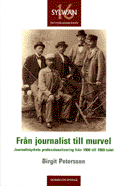
Från journalist till murvel: Journalistyrkets professionalisering från 1900 till 1960-talet


Nordicom-Sveriges Internetbarometer 2004
För femte året i rad presenteras Nordicom-Sverige Internetbarometer. Undersökningen som genomfördes 2004 stärker de tidigare årens mönster för tillgång och användning. Internetbarometern belyser aspekter av internet såsom befolkningens tillgång i hemmet, användningen en genomsnittlig dag i hemmet, utanför hemmet och totalt, tidpunkt för användning, användningsområden, användning under en genomsnittlig vecka samt en profil av internetanvändarens – och den som inte använder internet – övriga medieanvändning.

Den svenska mediemarknaden 2006
Nordicom har under senare år vid ett antal tillfällen redovisat kartläggningar och analyser av såväl den svenska som nordiska mediemarknaden. Nu presenterar Nordicom Den svenska mediemarknaden 2006. Det är en faktasammanställning rörande de större svenska medieföretagen med uppgifter om de två föregående årens ekonomiska utfall, marknadsandelar, ägarförhållanden, m m. Liknande uppgifter lämnas också för de största utländska medieföretagen. Sammanställningen inleds med en analys av medieägandet där förändringar och trender vad gäller mediemarknaden diskuteras.

Nordicom-Sveriges Mediebarometer 2005
En genomsnittlig dag 2005 tittade 86 procent av svenskarna på TV, 81 procent läste en dagstidning och 74 procent lyssnade på radio. Dessa tre var de bland allmänheten helt dominerande medierna. Andelen som använde Internet var 42 procent, andelen tidskriftsläsare var 41 procent, andelen bokläsare 38 procent, andelen CD-lyssnare var 35 procent. Lägst en genomsnittlig dag låg video/DVD 15 procent, mp3 10 procent, kassettband 4 procent, och bio en procent. 2005 var den samlade tiden för all medieanvändning, bruttotiden, 5 timmar och 41 minuter.

Implications of the Sacred in (Post)Modern Media
The news media report global conflicts related to religion. New expressions of religiosity and spirituality appear in popular media culture. The relation-ship between media and the sacred has become an inevitable topic.This book offers new and fresh perspectives on the media, the sacred and religion. It has a Nordic voice. This means that it focuses on empirical data collected from the Nordic countries.


Cultural Dilemmas in Public Service Broadcasting: RIPE@2005
In recent years public service broadcasting seems caught in a radicalized dilemma between two obligations. To serve and preserve national culture and identity has for decades been an essential mandated obligation. At the same time, being a ‘window to the world’ has also been central to the remit. How can PSB handle the challenges of being custodians of diluted national identities amid a variety of heterogeneous cultures on the one hand, and simultaneously acting as explorers of global orientation on the other?
Global War - Local Views: Media Images of the Iraq War
In this book, media scholars from a number of countries and cultures provide a more global view of the 2003 Iraq War and the War on Terror than is usually present in the news media. This book will assist journalists and media workers to reflect upon their own tradecraft and to make improvements when motivated.


Våld och pornografi i medierna
Medielandskapet har dramatiskt ändrat karaktär under det senaste decenniet genom den moderna informationsteknologin – med ett ständigt ökande medieutbud genom många nya kanaler. Vi har idag enorma möjligheter till inhämtande av kunskap och förströelse via TV-program, böcker, tidskrifter och Internet. Samtidigt uttrycker många föräldrar, lärare och politiska beslutsfattare farhågor för mediernas negativa inflytande på barn och ungdomar.