1
Introduction
Image: Asikkala, Finland, by Taneli Lahtinen
At a time when the global media landscape is fundamentally changing, it is becoming increasingly important to understand how the conditions for news media are developing.
The market for news media and journalism is in a rapid process of change. Technological development has decisively changed the conditions for producing, distributing, and consuming news journalism, and local and national news media today find themselves in a globally competitive situation where the fight for both audiences and advertisers is fiercer than ever.
The digitalisation and globalisation of the media landscape have also occurred in tandem with a more heterogeneous and politically polarised society. The early 2020s were characterised by the Covid-19 pandemic as well as a worsening security situation and increased economic instability around the world. These are also factors that have come to affect the conditions for news journalism in recent years.
At a time when the global media landscape is fundamentally changing, it is becoming increasingly important to understand how the conditions for news media are developing – both to protect the infrastructure of democracy and to ensure an informed public. The Nordic countries have long been considered role models in this regard, with strong public service institutions, high news media consumption, and historically well-functioning interactions between commercial and public actors in the news media market. But here, too, the professional news media are challenged by digitalisation, global competition, changing consumption patterns in the population, and increased political polarisation.
Based on a wide variety of publicly available and trustworthy data, this report presents a broad overview of the news media and their framework conditions in Denmark, Finland, Iceland, Norway, and Sweden in 2025. By clarifying both common features and national differences in the Nordic news media systems, the report contributes to the empirically founded knowledge about the interaction between media, the market, and democracy in a Nordic context.
One way for the Nordic news media companies to meet the challenges that have followed digitalisation has been to merge into larger units. In recent years, several major structural transactions have been carried out in the Nordic media markets, including across Nordic borders. Several of the largest Nordic media companies consequently also conduct news operations in other Nordic countries. The emergence of a common Nordic market for news journalism highlights a growing need for comparative Nordic overviews of the kind presented in this report.
A model for analysing media structures
The media landscape develops in close interaction with the surrounding society. According to an analytical model developed by the Danish media researcher Preben Sepstrup in 2004, the structure of the media market is shaped at the intersection of four interacting domains (see Figure 1.1).
It concerns, first, the composition of the media audience and the demand for different media and content; second, the development of the advertising market and advertisers’ demand to reach their target groups with their messages through the media; third, the media policy framework in the form of both general legislation and more media-specific regulations; and fourth, the development of media technology. The interaction between these four domains then shapes the structure of the media market, in terms of, for example, the number of media outlets, the content they convey, and how they are financed and controlled.
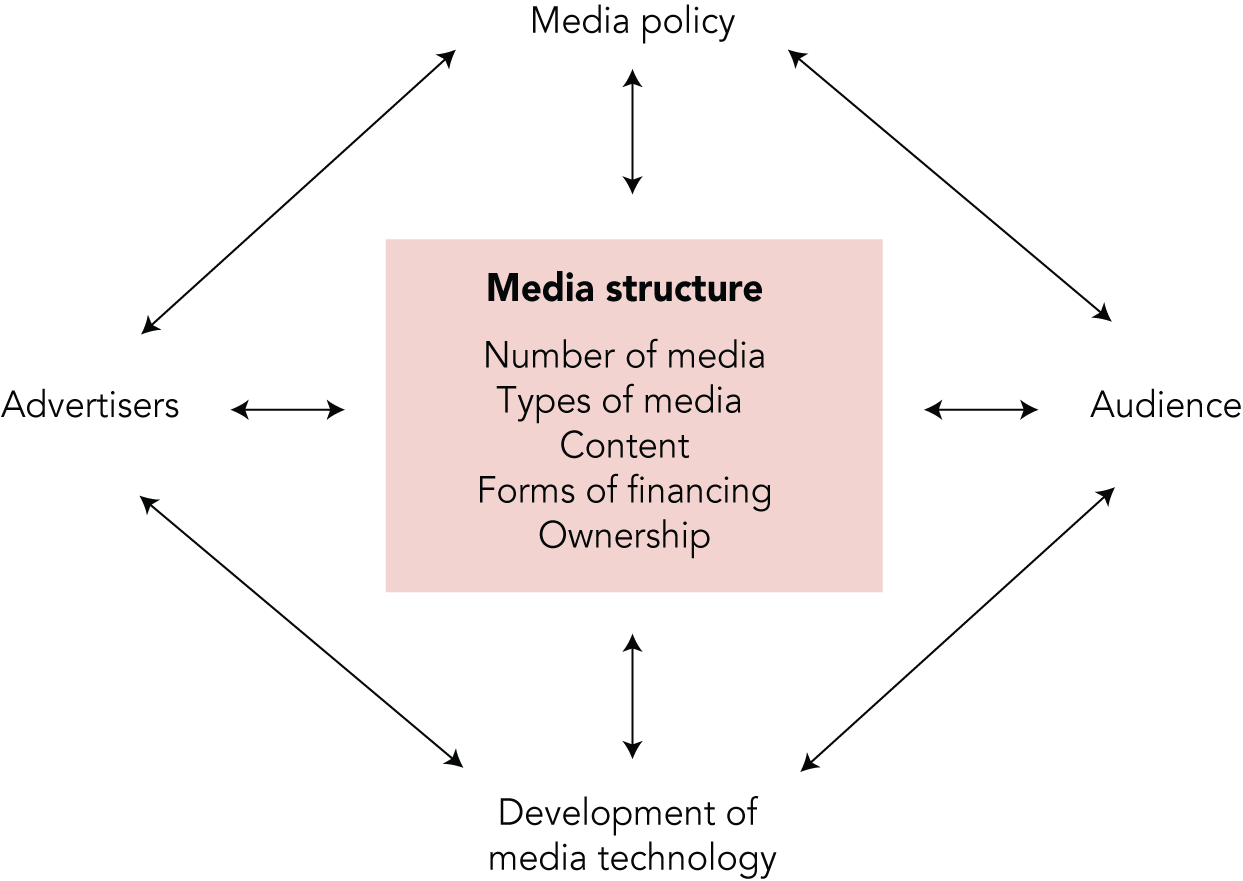
Source: Adapted from Sepstrup, 2004:16
With this approach, media policy and media technology developments can be said to constitute the external framework for a country’s media structure. Within this framework, the media structure is then shaped in a more market-based internal field of tension, where the media compete for audiences and advertising revenue based on the given political and technological context. Additionally, there are also larger overall changes of a macro nature, such as the global economy, economic cycles, and political shifts, which also affect the conditions for media market actors.
The overview presented in this report takes its starting point from this model.
Data sources and delimitations
The purpose of this report is to describe and compare the news media markets and their framework conditions in the five Nordic countries in 2025. The report relies on rich empirical material, obtained from independent and freely available data sources. We have sought to use the most recent data available when writing the report; in most cases, this means data from 2024. Also, our definition of news media corresponds mainly to professional editorial organisations aimed at continuously covering current affairs on the national or local levels, such as subscription newspapers or general news sites, freesheets, and public and commercial broadcasters. News media with a narrower focus area or niche, such as business, sports, or politics, have not been included, nor have news magazines, which typically have a longer, more in-depth format and a lower frequency of publication.
The comparative claim of the report means that it is primarily based on data and statistics that enable direct comparisons between the Nordic countries. This means that international and Nordic datasets with comparable data from several countries have been prioritised over nationally designed data collections or studies. The publicly funded statistical databases Nordic Statistics (Nordic Council of Ministers) and Eurostat (EU Commission) have been particularly important in this regard. They include quality-assured national statistics for a wide range of subject areas at the Nordic and European levels. This also means that in some parts of the analysis, data for individual Nordic countries is missing. This applies, for example, to statistics collected only among the EU member states (which do not include Norway and Iceland).
In cases where the data allows, comparisons are made between the Nordic countries and between the Nordics and the rest of Europe. In the same way, developments over time are reported where possible and when relevant. Generally, these are changes over the last five-year period, which usually means 2019–2024.
Although the primary purpose of this report is to describe and compare the Nordic markets for news journalism based on independent and freely available data, the report also serves as an introduction to the data sources available for this type of comparative overview. The free access to quality-assured data in the media field varies, both between different themes and between different countries, which has direct consequences for the conditions of empirically mapping the Nordic news media landscape in a fair and comprehensive manner. Unfortunately, this report provides ample evidence of cases where an empirically founded description of the framework conditions and reach of the news media in the Nordic region is hindered by the limited availability of trustworthy data.
Structure of the report
The remainder of this report has the following structure. In Sections 2 and 3, we examine the overriding framework conditions for the Nordic media systems and the population characteristics that are of fundamental importance for the structure, supply, and reach of the national news media in the region. In Section 4, we describe the national frameworks of media policy aimed at promoting the news media sector in the Nordic countries. This is followed by Section 5, where we describe the development of the Nordic advertising markets, and Section 6, where we discuss the audiences of the Nordic news media. Lastly, in Section 7, we describe the structure of the Nordic markets for news journalism, followed by a summary discussion and conclusions in Section 8.
The purpose of this report is to describe and compare the news media markets and their framework conditions in the five Nordic countries in 2025.